
Unlocking potential: Development finance reforms needed to support localized health product manufacturing
Published 8 January 2026 by PLOS Global Public Health, Sharonann Lynch.
While nearly half of the world lacks access to diagnostics [1], the world’s medicines and diagnostics are produced by a narrow set of global manufacturers, concentrated mostly in high-income countries. Except for a few key countries, low- and middle-income countries (LMICs) have historically played a limited role in manufacturing the health products needed for resilient health systems, contributing to pronounced inequity in access. In Africa over 70% of pharmaceuticals and 95% of active pharmaceutical ingredients are imported [2] and only 4% of diagnostics in Latin America were produced locally during the COVID-19 pandemic [3].
Communities worldwide face additional barriers to essential medicines and diagnostics due to United States foreign aid cuts [4]. Meanwhile, France, Germany, and the United Kingdom are reducing official development assistance by 9–17% in 2025 [5]. Consequently, multilateral development organizations are struggling to maintain their full operations amidst the large vacuum in global health funding [6]. Dependable access to health products and services for many communities remains precarious, with global funding cuts estimated to result in almost three million additional HIV-related deaths between 2025 and 2030, threatening decades of progress for the global HIV response [7].
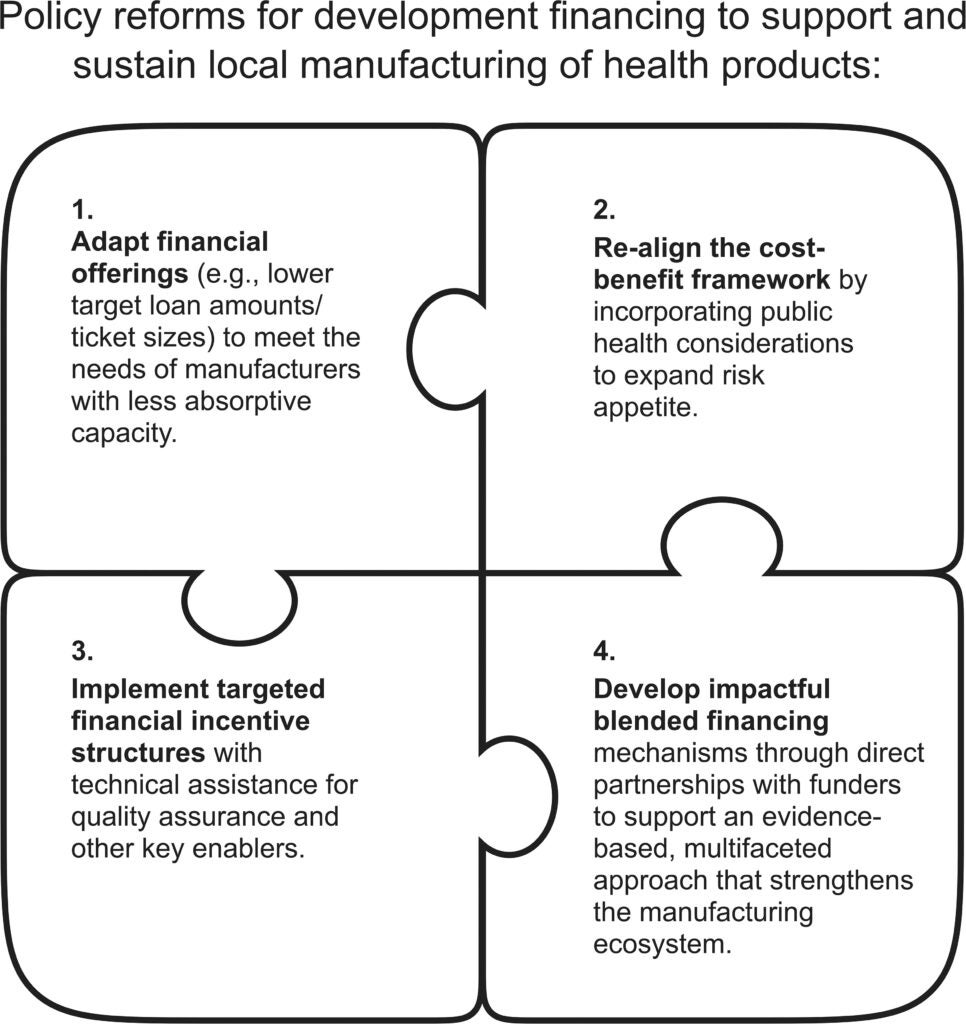
While there has been growing political momentum towards localizing health product manufacturing, current challenges facing the global health ecosystem have magnified the need for urgent action to secure sustainable access to health products across LMICs. Local manufacturing in LMICs can also help diversify supply chains and enable a more effective global response during future outbreaks. As international health funding drops to a 15-year low [8], development finance institutions (DFIs) across both high-income countries and LMICs have the opportunity and the imperative to step up to support long-term health security, adopting new strategies to increase the capital provided for scaling-up localized manufacturing.