
February Update | US leaves WHO, Allan Maleche joins the Center as Senior Scholar
February 6, 2026
Spotlight
In a new article for Science Politics, Matthew Kavanagh, Co-Director of the Georgetown University Center for Global Health Policy & Politics, argues that global health is facing a rupture, not a transition. Drawing on recent geopolitical shifts and the dismantling of U.S. global health engagement in 2025, the piece suggests that restoring past aid models is neither possible nor sufficient.
Critiques of aid are today being used to justify a more transactional and conditional model of engagement that mirrors rather than reduces the colonial relationships. Rather than seeking restoration of the aid model of the recent past, the article calls for a new vision of global health focused on reducing inequality, global public investment, strong civil societies, and removing the global economic rules that drive unequal access to medicines and health financing. Kavanagh argues that in a world where inequality fuels vulnerability, cooperation and solidarity are not ideals but necessities.
“In a world where diseases don’t respect borders, where inequalities fuel vulnerabilities, and where cooperation is the only viable defense, retreating into transactional aid or nostalgia for a bygone order is a luxury we cannot afford. The world must build something new, rooted in equity, solidarity, and shared humanity.”
👉 Read the full article: https://sciencepolitics.org/2026/01/26/the-rupture-in-global-health-is-a-warning/
New Publication in PLOS Global Public Health
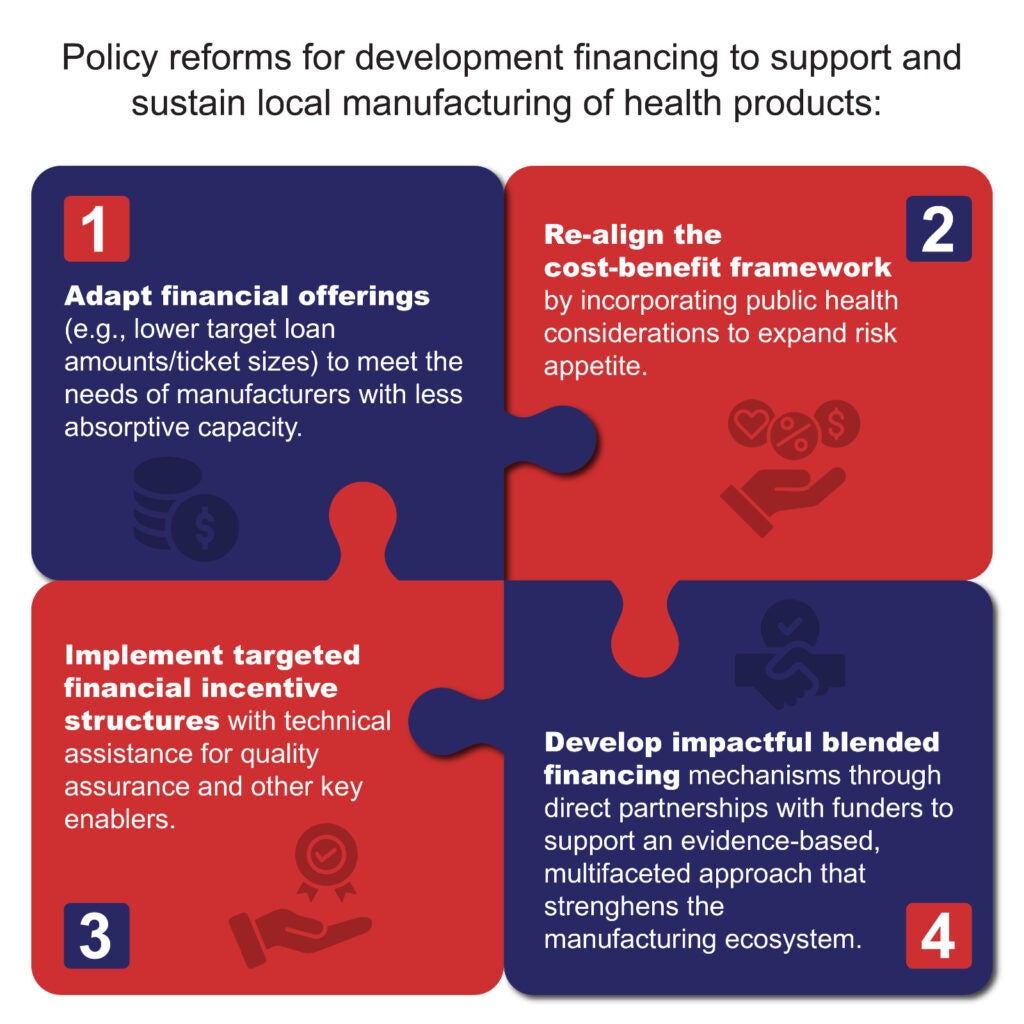
The Center’s Co-Director, Sharonann Lynch, recently co-authored a new commentary in PLOS Global Public Health, titled “Unlocking potential: Development finance reforms needed to support localized health product manufacturing.” Co-written with Ifedayo Adetifa (FIND), Jicui Dong (World Health Organization), Robert Matiru (Unitaid), and Cassidy Parshall (UAEM), the article makes the case for rethinking how development finance can support local and regional manufacturing of health products.
The authors argue that current financing models often overlook smaller manufacturers and public health priorities, limiting the ability of countries to build resilient supply chains. To address this, the commentary calls on development finance institutions to adopt more innovative approaches that strengthen local production capacity and advance long-term health security.
Key proposed reforms include:
1. Adapting financial offerings (so-called “ticket sizes”) to the needs of smaller and emerging manufacturers
2. Taking more risks and re-aligning cost-benefit frameworks to include public health goals
3. Creating targeted incentives to support quality assurance
4. Expanding blended financing through funder partnerships
👉 Read the full commentary: https://journals.plos.org/globalpublichealth/article?id=10.1371/journal.pgph.0005369
U.S. Withdrawal from W.H.O.: A Strategic and Public Health Setback
The U.S. is stepping away from the World Health Organization––a move with tangible consequences for both American public health and global governance.
WHO’s value is not theoretical. It provides early-warning intelligence on emerging pathogens, shapes global vaccine strategy, and convenes the scientific consensus to affect global health topics from HIV treatment to pandemic preparedness. By exiting, the U.S. loses access to cutting-edge global science on HIV, cancer, and vaccines. Attempts to replace WHO with bilateral deals or new coalitions simply cannot replicate the coordination and trust that the WHO provides.
Our work at the Center for Global Health Policy & Politics serves as a reminder that protecting health requires active engagement in global governance. Policy, governance, and diplomacy shape the effectiveness of global health interventions, and walking away from WHO weakens all three.
Allan Maleche joins the Center as Senior Scholar
The Center for Global Health Policy & Politics is pleased to announce that Allan Maleche has joined the Center as a Senior Scholar.
Allan is a Kenyan human rights lawyer and Advocate of the High Court of Kenya with over 15 years of experience at the intersection of health, human rights, law, and governance. As Executive Director of the Kenya Legal and Ethical Issues Network on HIV and AIDS (KELIN), he has led nationally and internationally recognized rights-based legal and policy work to improve access to healthcare and justice for communities facing systemic exclusion.
In addition to his national leadership, Allan plays a prominent role in global health governance. He currently serves as Co-Chair of the Gender Advisory Panel of the WHO-hosted HRP Program, and previously co-chaired the UNAIDS Human Rights Reference Group. His experience also includes senior roles in global health financing and accountability, including service on the Global Fund Board and membership in the International AIDS Society–Lancet Commission on Health and Human Rights.
We are excited to welcome Allan to the Center and look forward to the perspective he brings to our research and teaching.

Upcoming DEC Webinar Series: Scaling Up Near-Point-of-Care TB Testing
Join the Diagnostics Equity Consortium (DEC) for a two-part Study Club webinar series on new near-point-of-care (nPOC) TB diagnostics and their role in expanding testing coverage through decentralized primary health care settings.
Part 1: 25 Feb 2026 | 8am ET | 2pm CET | 3pm SAST | 4pm EAT |6:30pm IST
Scaling up new near point-of-care TB tests
We’ll delve into the latest new near point-of-care (nPOC) TB diagnostics, Global Fund rollout support, and community perspectives on moving from innovation to scale up.
Register here for Part 1: https://georgetown.zoom.us/webinar/register/WN_BaGDCLCwT_-mWiocQv7_Mg
Part 2: 18 Mar 2026 8am ET | 2pm CET | 3pm SAST | 4pm EAT |6:30pm IST
Advocacy to scale up new TB tests
We’ll explore costing tools for nPOC TB diagnostics, regulatory pathways, and strategies to ensure nPOC TB tests are included in Global Fund Grant Cycle 8 (GC8) proposals.